
What Is Variance in Casino Games?
Variance is a statistical concept that explains why a casino game can feel like a roller coaster. For a related practical reference, mino casino can complement these steps. When you spin a slot or place a bet at a table, the outcome may stay near the expected value for a stretch and then swing wildly, creating that thrilling unpredictability. For a deeper dive into how variance affects your bankroll, check out for a detailed guide. Understanding this idea helps you separate the natural ups and downs from a truly poor strategy, letting you make smarter choices in the casino environment. Even seasoned players sometimes misinterpret variance as luck, but in reality it is a measurable risk factor that can be quantified. By learning how to calculate variance, you gain a clearer picture of the expected range of results over many plays, which is essential for long‑term planning at any casino.
• Certain casino games sit at the low end of the variance spectrum, while others occupy the high end
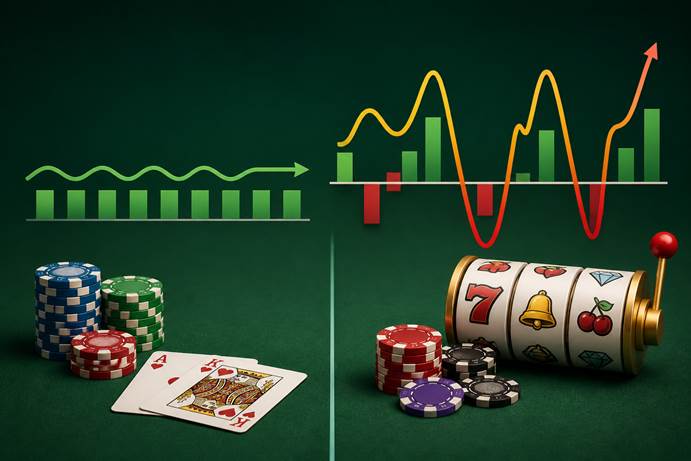
• Blackjack, when played with optimal strategy, typically has low variance because the house edge is small and the outcomes are relatively stable
• In contrast, progressive slots or high‑limit baccarat can exhibit extreme variance, where a single spin or hand can swing a player’s bankroll dramatically
• Even within a single casino, a low‑variance slot machine can coexist next to a high‑variance jackpot machine, offering players a diverse array of risk profiles
• When you select a casino game, think of variance as a dial that you can adjust to match your risk appetite
• If you prefer steady, predictable action, choose low‑variance titles—slots with frequent small wins or table games with a small house edge
• The key is to pick a game whose variance aligns with your comfort level and bankroll
Understanding Variance
At its core, variance measures the spread of a game’s outcomes around the mean, or the expected value you would obtain if you played the game an infinite number of times. In casino terms, the mean represents the average return you would receive per bet over a long period. If every spin paid the same amount, variance would be zero, meaning outcomes are perfectly predictable. Conversely, a high‑variance game produces results that diverge widely from the mean, giving players occasional big wins and frequent small losses.
|
Area |
What to know |
|
Context |
At its core, variance measures the spread of a game’s outcomes around the mean, or the expected value you would obtain if you played the game an infinite number of times. |
|
Consideration |
Certain casino games sit at the low end of the variance spectrum, while others occupy the high end. |
|
Practical takeaway |
Recognizing the variance of a casino game is crucial for effective bankroll management. |
Certain casino games sit at the low end of the variance spectrum, while others occupy the high end. Blackjack, when played with optimal strategy, typically has low variance because the house edge is small and the outcomes are relatively stable. In contrast, progressive slots or high‑limit baccarat can exhibit extreme variance, where a single spin or hand can swing a player’s bankroll dramatically. Even within a single casino, a low‑variance slot machine can coexist next to a high‑variance jackpot machine, offering players a diverse array of risk profiles.
Recognizing the variance of a casino game is crucial for effective bankroll management. In a high‑variance setting, you need a larger cushion to survive inevitable dry spells; a small bankroll can be wiped out quickly. Low‑variance games, by contrast, allow tighter budgets because the outcomes cluster closely around the mean, reducing the frequency of large swings. By aligning your bankroll size with the variance profile of the casino game you choose, you can avoid chasing losses that the math tells you are unlikely to recover in a single session.
What Defines Variance
When you select a casino game, think of variance as a dial that you can adjust to match your risk appetite. If you prefer steady, predictable action, choose low‑variance titles—slots with frequent small wins or table games with a small house edge. If you are chasing the thrill of a massive payout, a high‑variance slot or a high‑stakes table game might suit you better, provided you are comfortable with the larger swings. The key is to pick a game whose variance aligns with your comfort level and bankroll.
A Closer Look at Variance
Ultimately, variance is not a mystery; it is a predictable factor that turns the seemingly chaotic feel of casino play into a manageable part of your strategy. By recognizing how variance operates, you can match the game to your risk appetite, keep your bankroll healthy, and enjoy the excitement that only a casino can offer. A solid grasp of variance transforms every spin, every hand, and every bet into a calculated decision rather than a gamble of pure chance.